This is a message for the managers and aspiring leaders of our industry. If you have ever watched a promising new agent leave the business within their first twelve months, full of potential, full of enthusiasm and wondered what went wrong, I want to speak directly to that experience today.
Because in most cases, what went wrong did not happen in month nine or month eleven. It happened in the very beginning. Before the contract was signed. Before the first training session. Before the first call was ever made.
The early stages of a manager’s relationship with a new agent are not administrative. They are foundational. And what we build or fail to build in those first weeks and months will determine everything that follows.
The Problem We Do Not Talk About Enough
We celebrate production in this industry. We honour the top performers, recognise the qualifiers, and applaud the branches that hit their targets. That recognition is deserved. But there is a conversation we continue to avoid about the professionals who arrived with real potential and were gone before the year was out.
We call it infant mortality. And it is one of the most persistent and costly challenges facing managers across the Caribbean today.
It costs the manager time. It costs the company resources. It costs the individual their confidence, their income, and sometimes their belief in what this profession can offer them. And in far too many cases, it was entirely preventable.
The cause is rarely the candidate. More often, it is the process or the absence of one.
Be First in When the Academy Opens The Carlyle Fletcher Global Academy is coming. Register your email address now and you will be first to know when it launches, with early access and founding member pricing.
Recruiting Is the Lifeblood of the Business
Let me state something plainly: recruiting is to the manager what prospecting is to the agent. It is not a task to complete when numbers fall short. It is a discipline to be practised consistently, systematically, with structure and intention.
A manager who is not actively recruiting is managing a branch that is quietly declining. The pipeline shrinks, the pressure builds, and decisions get made in haste. And when we recruit in haste, we set both ourselves and the candidate up for a difficult journey.
What we need instead is a profile. Before a single conversation takes place, we should be able to answer a straightforward question: what does our ideal candidate look like? What is their background? What habits do they already carry? What life experience suggests they can handle the transition ahead?
That profile is not a wish list. It is a working tool. It gives the manager a standard to recruit toward and a basis for making disciplined decisions when the pressure to fill seats is high.
Selection Is a Skill, Not a Formality
Once we have the right profile, we still face the work of selection. And this is where many managers treat a critical step as though it were a checkbox.
Group recruiting has its place. It is efficient. It creates energy. It allows us to reach a number of candidates at once. But not every candidate in that room belongs in this business, and efficiency must never replace discernment.
Individual recruiting, the deliberate, one-on-one process of identifying and approaching specific candidates, demands more time, but it produces more informed decisions. When we take the time to evaluate a person properly, we give ourselves and them a far better chance at a good outcome.
The pre-contract period is one of the most underused tools available to us. A structured programme before the contract is signed allows the manager to observe a candidate over time. It answers the most important question we face in recruiting: will this person follow through? Not whether they can but rather whether they will.
Commitment shown before a contract is a far more reliable indicator than enthusiasm expressed at an interview.
The Best Time to Begin Training Is Before Recruitment
I have said this on platforms from Port of Spain to Los Angeles to Miami, and I will say it again here: the best time to begin training is before the agent is officially recruited.
A structured pre-recruitment training programme does several things at once. It prepares the candidate for the realities of the role, prospecting, approaches, presentations, fact-finding, and closing. It allows the manager to observe how they learn, how they handle difficulty, and whether they apply what they are taught. This gives the candidate a genuinely informed choice about whether this career is right for them.
That last point matters more than we sometimes acknowledge. When a candidate walks into this business having already been exposed to its fundamentals, they are not choosing blind. And when they choose under those conditions, they are more likely to stay.
One principle I hold firmly: a trainer’s performance is not measured by what the trainer knows. It is measured by what the trainee can do. That distinction should shape every session we design and every evaluation we conduct.
The Digital Academy Is Coming
The Carlyle Fletcher Global Academy is being built for agents, managers and leaders across the Caribbean. Register now for early access and founding member pricing.
Reserve My PlaceSupervision and Management Are Not Optional
There is one more piece of this that we must address honestly.
Many of the people who come into our business arrive from structured employment roles where expectations were clear, schedules were set, and someone was accountable for their development. They were managed. They were directed. They knew exactly what was expected of them each day.
And then they join an insurance agency and, in many cases, are pointed toward a desk and told to get started.
The shift from structured employment to self-directed performance is significant. For some, it is genuinely daunting. Without strong supervision and consistent management support during that transition, the early failure rate rises sharply. We lose people who had everything needed to succeed, simply because we did not provide the structure they needed in the moments that mattered most.
Supervision is not micromanagement. It is the responsible application of leadership during the period when new agents are most vulnerable. It is how we protect our investment in them and theirs in us.
Build the Beginning With Intention
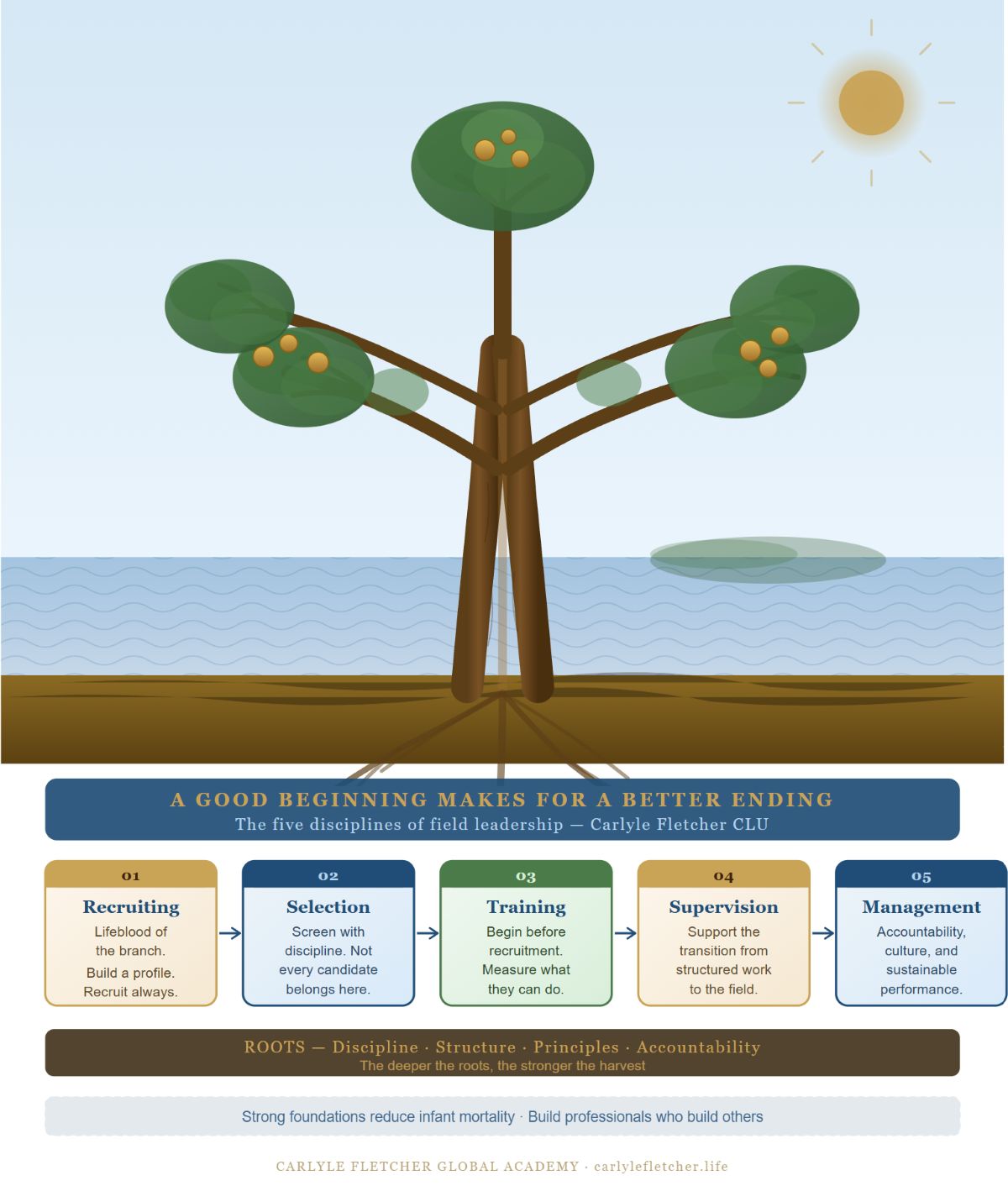
The session I delivered at the MDRT Annual Conference in Miami was built around a simple idea that I have carried throughout my thirty years as a branch manager: a good beginning really does make for a better ending.
The five disciplines of recruiting, selection, training, supervision, and management, are not separate functions. They are a sequence. Each one depends on the one before it. When we execute them with discipline and structure, we do not just reduce infant mortality. We build professionals who stay, who grow, and who eventually develop others.
That is the result that makes this work meaningful.
If you are a manager reading this today, I want to encourage you to look honestly at your current onboarding process. Where does structure exist? Where does it break down? Where are candidates being evaluated and where are they simply being accepted?
The beginning of a new agent’s career is not a formality to move through. It is the most important investment we make in their future and in the future of our branches. Treat it accordingly.
Build it with intention. Protect it with discipline. And watch what follows.
The Needs Analysis Every New Agent Should Master
Carlyle Fletcher CLU walks through a complete client fact-find, calculates the coverage gap, and presents the case from first principles to the close. A practical resource to put in front of every agent you bring on board. 14 minutes. One payment. Lifetime access.
Watch Now for US$19.95