Developing Insurance Managers
I have sat with managers across the Caribbean and listened to the same concern repeated in different rooms, at different tables, in different organisations. Production is down. Agents are leaving. The branch is not growing the way it should. And almost without fail, when we trace the problem back to its source, we arrive at the same place. It did not start with the market. It did not start with the product. It started the day we decided to hire someone we should not have hired.
The Mud on the Wall Approach Has No Place in Modern Insurance Leadership
For years, some managers described their recruiting approach in terms I found troubling even then. Throw enough mud on the wall and some of it will stick. It was treated as wisdom. It was not. It was an admission that no real process existed. And the tragedy is that in too many places across our industry today, that same thinking is still quietly at work, just dressed in more modern language.
We are bringing people into this profession and hoping for the best. We are skipping the selection conversation because we are under pressure to fill a seat. We are measuring success at the point of hire rather than at the point of performance. And then, six months later, we are sitting in review meetings wondering why the numbers look the way they do.
A performance problem that appears in the third quarter was usually created in the first week.
Inferior Raw Material Cannot Produce a Superior Finished Product
There is a principle I return to often in my work with managers across Trinidad and Tobago and the wider region. If you begin with inferior raw material, no process in the world will produce the result you need. You can train, coach, supervise, and support. But if the foundation was wrong from the start, you are working against yourself from day one.
This is not about judging people. It is about respecting the profession enough to be deliberate about who we invite into it. Every unsuitable candidate who enters because we abandoned the selection process is one more person likely to leave within twelve months. That is what we call infant mortality in this business, and it costs us more than we calculate. It costs in training time, in management attention, in client relationships, and in the morale of the agents around them who are watching.
Recruiting is to the manager what prospecting is to the agent. You would not tell an agent to skip their prospecting process and simply hope that business materialises. The same principle applies to building your team. A structured approach to finding the right people is not optional. It is the work.
Learn to Recruit Like a Field Leader
The Carlyle Fletcher Global Academy is being built for agents, managers and leaders across the Caribbean, with a full Management Fundamentals module on recruiting, selection and pre-contract orientation. Register now for early access and founding member pricing.
Reserve My PlaceThe Four Fundamentals We Cannot Afford to Skip
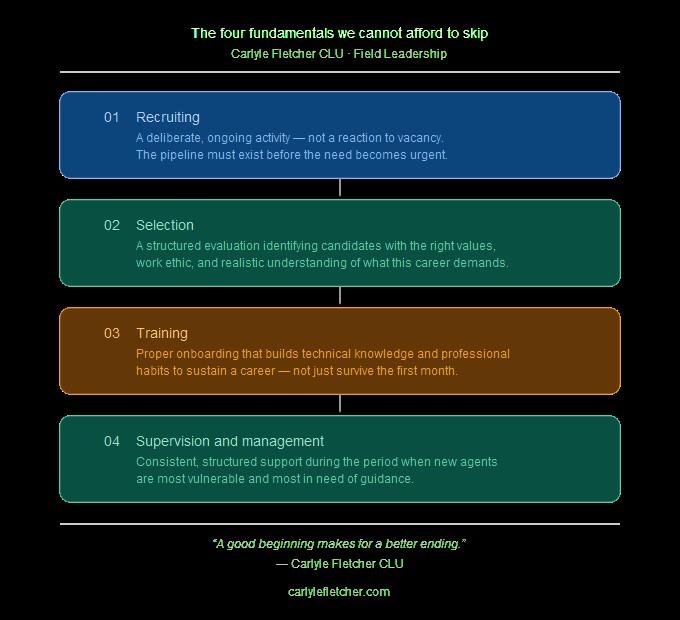
Over more than forty years in the field, I have seen what separates branches that grow consistently from those that struggle in cycles. It comes down to how seriously the leadership applies four non-negotiable fundamentals.
- Recruiting: A deliberate, ongoing activity, not a reaction to vacancy. The pipeline must exist before the need becomes urgent.
- Selection: A structured evaluation process that identifies candidates with the right values, work ethic, and realistic understanding of what this career demands.
- Training: Proper onboarding that builds both the technical knowledge and the professional habits an agent will need to sustain a career, not just survive the first month.
- Supervision and management: Consistent, structured support during the period when new agents are most vulnerable and most in need of guidance.
These four steps are not new. They have been tested and proven across the best-performing agencies in this industry for decades. The problem is not that we do not know them. The problem is that we cut corners when the pressure is on, and we pay for it later with the very performance problems we were trying to avoid.
“The best time to begin training is before the agent is recruited.”— Carlyle Fletcher CLU, MDRT Focus Session 2025
A Good Beginning Makes for a Better Ending
Watch the Fact-Find Done Properly
A structured recruiting process only pays off once the agent it produces can run a disciplined client conversation. Watch Carlyle Fletcher CLU conduct a complete fact-find, calculate the coverage gap and close the case. 14 minutes, one payment, lifetime access.
Watch Now for US$19.95I say this to every manager I work with: if you want to understand your performance results, look first at your recruiting process. Not your training programme. Not your activity system. Your recruiting process. Because every good agent you have today passed through a door that you opened, and every vacancy, every disappointment, and every early departure likely passed through a door you opened without enough care.
We have a responsibility, as field leaders, to treat recruitment as the serious professional discipline it is. Not a task to complete when numbers fall short. A continuous, structured commitment to finding and developing the right people, the right way.
Start there. Review your selection criteria, tighten your process, and commit to building a pipeline before you need one. That is where sustainable performance begins.
Frequently asked questions
Why do most performance problems trace back to recruitment?
Because an agent’s early success is shaped long before their first sale. If the wrong candidate is hired to fill a number rather than fit the role, no amount of training or coaching afterwards can fully correct that starting point. The performance problem shows up later, but the decision was made at recruitment.
What does a proper recruiting process for insurance agents include?
A structured process identifies suitable candidates, verifies them through multiple interviews and reference checks, and confirms aptitude with psychometric testing. It also includes a pre-contract orientation programme, giving both manager and candidate an honest look at the role before any contract is signed.
Does recruiting well reduce management problems later?
Yes. Recruiting properly at the outset makes ongoing management considerably easier, because the agent already fits the role and understands its demands. Recruiting on hope or convenience shifts that burden onto the manager, who then has to manage around problems that could have been avoided.